
Meet Serevin.
A capital workspace for Robinhood Chain, and a home for the next chapter of SVRN.
A token launch is a beginning. What matters next is what people can do with it.
SVRN is now live on Long, paired with Artificial Inu, AI, on Robinhood Chain. Serevin is the product taking shape around that token: a place to understand markets, compare routes, manage capital and participate in services with clear terms.
Open the application to explore five reviewed Morpho lending markets and prepare supported actions directly from your wallet. Compare Route aggregation with direct Uniswap quotes, inspect SVRN/AI and look up public wallet positions. The first funded SVRN staking campaign is activated. Serevin’s own credit, reserve and membership services, and additional farming programs, remain in development.
A workspace that shows its work
DeFi decisions often start with scattered information. A price sits in one interface, the loan behind it sits in another, and the reason a quote changed is hard to see. Serevin puts the useful context beside the decision: the asset and contract, the underlying venue, the observed block and the available route.
A lending market’s supplied balance is not a promise of instant borrowing capacity. A spot price is not a guaranteed executable quote. The workspace makes those distinctions visible. Stock Token and crypto routes can appear in the same comparison flow when the underlying venues support them, with their actual availability and restrictions.
Give every pool of capital a clear job
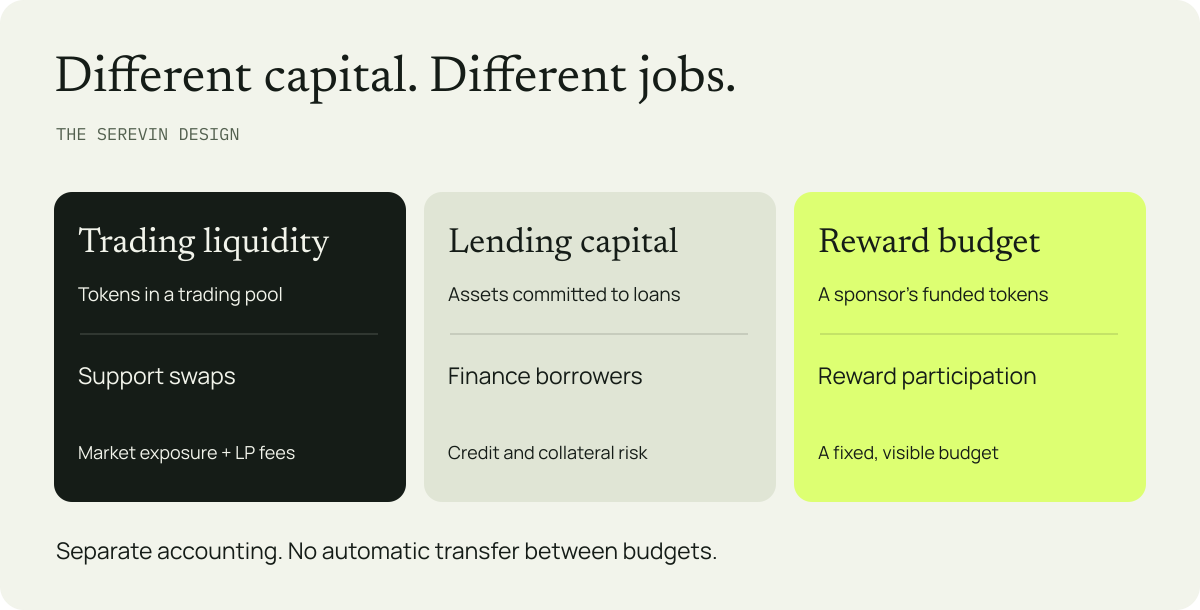
Our design for the financial services follows a straightforward rule: identify what has actually been funded, who has a claim on it and how it can leave.
Trading liquidity helps people exchange assets. Lending capital finances a borrower. Reserve assets support a defined redemption mechanism. A reward budget pays a specific campaign. Those balances need their own accounting. The Long launch does not automatically supply loan cash, reserve backing or staking rewards.
SVRN should have a reason to be used
Speculation alone is a thin foundation for a protocol token. The direction for SVRN is participation in useful services.
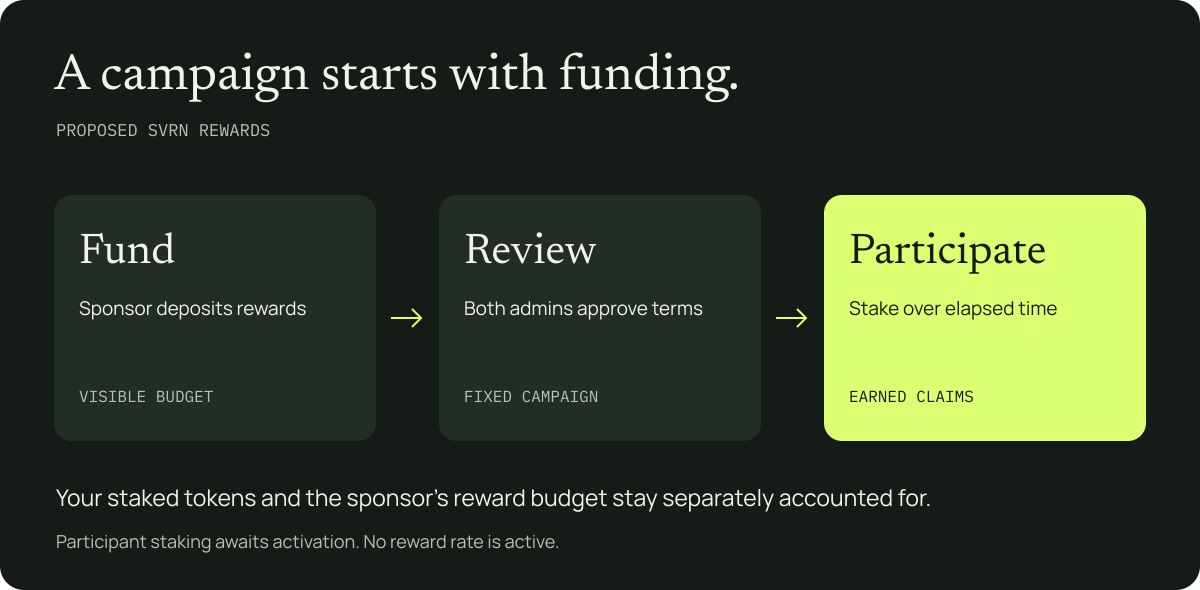
One path is membership: a defined token commitment in exchange for a finite service allowance. Another is funded staking, where participants earn a share of a sponsor’s committed reward budget over time. A third is ecosystem campaigns, where projects propose a useful activity, fund an incentive and reach participants through Serevin.
These roles have different costs and rights. Membership is service access. A staking campaign has its own reward asset, schedule and budget. Ordinary holding does not automatically create a claim on protocol revenue or the treasury.
Rewards that start with a budget
The first campaign is backed by 23,870,457.752907699889124185 SVRN in registered rewards, with a total staking cap of 250,000,000 SVRN. Both administrators authorized its terms, and activation was confirmed on September 9, 2026 in Robinhood Chain block 58,700,065. View the activation receipt.
Rewards run for 90 days, from through . Staking can open before rewards begin. Participation is measured across elapsed time, so joining later does not capture rewards earned before entry. There is no contractual stake lock or staking, withdrawal or claim fee. Network gas still applies.
Staked principal and reward funds are accounted for separately, even if both use SVRN. Ordinary withdrawal and claiming are separate actions. The contract does not require a token-emission schedule or promise a fixed APY. Its registered budget and dates are fixed after activation; this campaign cannot accept normal top-ups. The staking page checks the current contract state, terms and capacity before allowing a new stake. Later pauses, recovery or contract changes can restrict availability. The funding desk retains the contribution records.
The more distinctive opportunity is a shared campaign system for the ecosystem. A project could sponsor a reviewed program for SVRN participants instead of building its own staking product from scratch. Serevin could provide the infrastructure, discovery and transparent terms. Any platform fee would be stated before participation, and its rate still needs to be chosen.
Farming should reward useful liquidity
Liquidity farming belongs in that picture, but it needs more than a pool name and an APY badge. An eligible position must have a verified owner, clear withdrawal rights and a defined way to measure its contribution. Trading fees and extra campaign rewards should be shown separately.
Uniswap v4’s position subscribers offer an interesting direction: programs can receive position-change notifications without requiring the owner to hand over the NFT. We are investigating that approach for future incentives. It is existing Uniswap infrastructure, and compatibility with the exact Long hook still needs to be established.
The current SVRN/AI launch does not establish a transferable LP receipt that can be deposited into a Serevin farm. Our first campaign accepts SVRN; an NFT-position farm needs a separate reviewed integration. Providing liquidity also brings price and range risk, including losses relative to simply holding the assets.
Build revenue around services people want
The commercial direction is to charge transparent fees for useful work: credit services, execution, campaign infrastructure and optional membership. Collected surplus could then fund operations, development, approved rewards or buybacks under a separate policy.
A user’s deposit is an obligation, not protocol profit. Buying and burning tokens also cannot guarantee appreciation. Long creator fees, lending income and campaign budgets each have their own source and beneficiary. The final fee rates and allocation policy have not been activated.
What makes Serevin different
The distinction we are building is the connection between these pieces: a Robinhood-native workspace, funded credit and treasury services, and a campaign system that gives SVRN participants a role across projects. It is a product direction grounded in explicit capital and useful actions.
That comes with visible controls. Either administrator can pause new risk. Both must approve upgrades and fund recovery, and recovery can include participant assets. The protocol guide describes those powers and the risks of each module. The rewards campaign is activated, but it has not completed an independent smart-contract security audit. Additional financial services need their own approved terms, funding and review before release.
Serevin is open to explore today. The next releases should earn their place the same way: useful functionality, clear terms and evidence that the underlying system does what it says.
Serevin is independent and is not affiliated with or endorsed by Robinhood, Long or the other protocols mentioned. This article describes the product and its development direction, not a return forecast or an offer of guaranteed rewards. Review the current release status and risk disclosure before participating.